
Before Dollywood. Before the Grammy Awards. Before the sold-out world tours and the Imagination Library. There was a barefoot girl from a one-room cabin in Locust Ridge, Tennessee, sitting on a rock with a guitar and a head full of dreams.
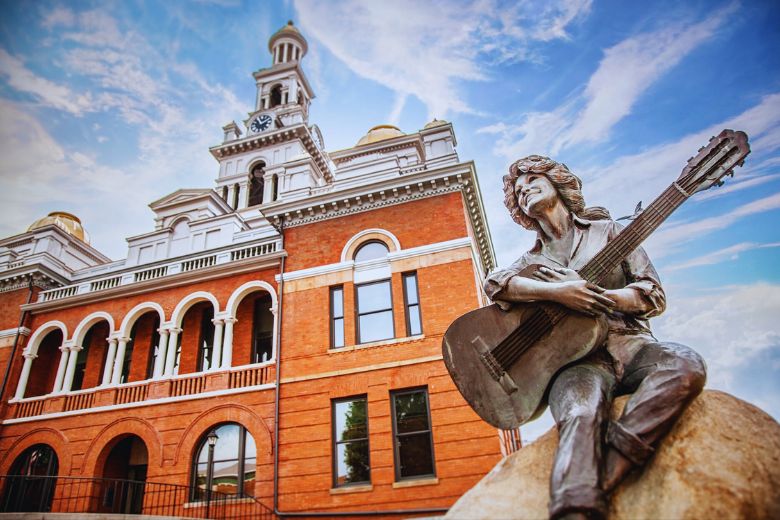
That's the Dolly Parton you'll meet in Sevierville — a bronze statue portraying Dolly as a young woman, perched on a rock while casually strumming her guitar, beaming her signature smile, likely dreaming about the renown she'd later bring to her hometown. It's one of the most photographed landmarks in the Smoky Mountains, and one of the most genuinely moving — because it captures the beginning of a story everyone in this region knows by heart.
Here's everything you need to know before you visit.
Where Is the Dolly Parton Statue?
The Dolly Parton Statue is located at 125 Court Avenue on the East Lawn of the historic Sevier County Courthouse in downtown Sevierville, Tennessee.
It couldn't be easier to visit — it's located in the center of the Sevier County Courthouse lawn in the heart of Sevierville. The courthouse's clock tower is visible from a distance, so you'll spot it before you even find the statue.
GPS address: 125 Court Ave, Sevierville, TN 37862
Driving from Pigeon Forge: Head north on the Parkway. After crossing the river, the road splits — turn left onto Forks of the River Parkway, then right onto Bruce Street. The courthouse clock tower will be visible on your left within a block.
Driving from Gatlinburg: Take the Parkway (US-441) north through Pigeon Forge and follow the signs to downtown Sevierville.
From US Hwy 441/Hwy 66, turn east at the "downtown" sign onto Bruce St., then drive one block to Court Ave. and the courthouse square.
Parking
Street parking is available around the courthouse square. There is easy and free parking in the immediate area — visitors consistently report it's one of the least stressful parking situations in the entire Smokies region. A refreshing change from Gatlinburg and Pigeon Forge's busier lots.
Hours & Admission
The statue is open to the public year-round and is free to visit. There's no ticket, no admission fee, and no closing time — you can visit at any hour, in any season. The statue is outdoors on the courthouse lawn, fully accessible 24/7.
The Story Behind the Statue
Sevier County wanted to show their gratitude to Dolly by commissioning a statue made in her honor. They contacted local artist Jim Gray to make the statue that now resides in front of the courthouse. Jim Gray is part of the cultural landscape of the Smokies — he moved his entire family here in the 1960s to begin capturing the area he loved and called home. Gray is most well known as a painter, with galleries located all over the area, but he is also a talented sculptor.
The life-size bronze sculpture took over 2,000 hours to complete. It was unveiled on May 3, 1987 — exactly one year after the opening of Dollywood — to a crowd of Sevier County residents who turned out to honor their most famous daughter.
The plaque on the boulder reads: "Dolly — Jim Gray, Sculptor. This statue of Dolly Parton was erected through the generosity of the people of Sevier County. Dedicated May 3, 1987."
Dolly has said that the statue is one of the things she's proudest of in her entire life and career — not the Grammy Awards, not the record sales, but the fact that her hometown thought enough of her to put her in bronze on the courthouse lawn.
And then there's this detail, shared in interviews over the years: for the first few years after the statue was unveiled, Dolly's dad would put a bucket of soapy water in his pickup truck and drive to the courthouse square every night to clean the pigeon droppings off the statue. No one asked him to. He just did it because it was his daughter, and it needed doing.
What to See at the Statue
The statue itself is Jim Gray's beautiful bronze of young Dolly sitting barefoot on a mountain boulder with her guitar. The detail work is incredible, and it's designed so you can sit right beside her for photos. The butterfly perched on her guitar is Dolly's personal symbol — representing the freedom and gentleness she's always associated with. A butterfly even appears as the "W" in the Dollywood sign.
The Tennessee Music Pathways marker sits right beside the statue — this official marker tells Dolly's story and her connection to Tennessee music history. It's part of the statewide trail celebrating the state's musical heritage.
The Sevier County Courthouse itself is worth a few minutes of your time. Built in 1895 in Beaux Arts style by the McDonald Brothers of Louisville, it's a genuinely striking building — tall, brick, and visible from well outside downtown. One of the most photogenic courthouses in Tennessee.
Photo Tips
Sit beside Dolly. The statue is positioned so visitors can sit on the rock right next to her — this is how the artist intended it to be experienced, and it makes for a far more personal photo than standing in front of it.
Morning light is best. The east-facing lawn catches soft morning light that flatters the bronze beautifully. Midday sun in summer creates harsh shadows.
Use the courthouse as your backdrop. Frame the shot with the 1895 courthouse clock tower behind Dolly for the most dramatic composition.
Visit the Wings of Wander Mural too. Just a minute's walk away at 111 East Main Street, this mural features giant painted butterfly wings — a perfect complement to the Dolly butterfly theme, and ideal for a second photo stop.
The Full Dolly Hometown Experience
The statue is the centerpiece, but it's part of a 28-stop downtown walking tour of Dolly's hometown. Give yourself an hour and make a proper morning of it.
Wings of Wander Mural — 111 East Main Street, one minute on foot from the statue. Giant butterfly wings painted on a building wall — a Dolly-themed photo backdrop that's become its own draw.
The Pines Downtown — The building where teenage Dolly performed her first paid gig is now The Pines Downtown, with bowling, arcade games, and food. You can play games and eat in the same spot where Dolly's professional career began.
Sevier County Heritage Museum — Located near the courthouse, the museum documents the history of Sevier County from Native American settlement through the 20th century, with exhibits on Appalachian culture and local families — context that makes the Dolly story land even more meaningfully.
Downtown Sevierville dining — There are great restaurants in the area. The downtown square has cafes and local spots that offer a quieter, less tourist-saturated meal than anything on the Pigeon Forge or Gatlinburg Parkways.
Dolly's Sevierville Story
For visitors who want a bit more context before they visit:
Dolly Rebecca Parton was born January 19, 1946, the fourth of twelve children, in a one-room cabin on the banks of the Little Pigeon River in Locust Ridge — a community just outside Sevierville. Her family was, by any measure, poor. She has described her childhood home as a place where her mother made her a coat of many colors from rags and scraps, a coat that Dolly wore with immense pride and that later became one of country music's most famous songs.
She wrote her first song at age five. She performed her first paid show at The Pines theater in Sevierville as a teenager. The day after she graduated from Sevier County High School in 1964, she got on a bus to Nashville with a suitcase, a guitar, and the absolute certainty that she was going to make it. She was right.
Sixty years later, she is one of the best-selling music artists of all time, the founder of the Imagination Library (which has distributed over 200 million books to children worldwide) and the most beloved figure in the history of this region. Every time someone visits the Dolly Parton statue, they're standing at the beginning of that story.
Frequently Asked Questions
Where exactly is the Dolly Parton statue? At 125 Court Avenue on the East Lawn of the historic Sevier County Courthouse in downtown Sevierville, Tennessee. Free to visit, open year-round, 24/7.
Is the Dolly Parton statue free to visit? Yes — the statue is open to the public year-round and is completely free to visit. No tickets, no admission fee.
Who made the Dolly Parton statue? Sculptor Jim Gray, a Smoky Mountains-based artist who took over 2,000 hours to complete the bronze. The statue was unveiled on May 3, 1987, exactly one year after the opening of Dollywood.
How far is the Dolly Parton statue from Dollywood? About 5 miles — roughly a 10-minute drive. Both are easy to combine in a single day, or the statue makes a natural stop on your way into or out of the Pigeon Forge/Gatlinburg area.
Is there parking at the Dolly Parton statue? Yes — there is easy and free parking in the area. Street parking around the courthouse square is the most convenient option and is consistently available.
Can I sit next to the Dolly statue for a photo? Yes — the statue is designed so you can sit right beside her for photos. Sitting on the rock next to Dolly is the intended way to experience it.
Stay in Dolly's Backyard
The Dolly Parton statue is just a few miles from Colonial Properties' Sevierville cabin rentals — and a short drive from Pigeon Forge cabins near Dollywood. Pair a downtown Sevierville morning with an afternoon at Dollywood and an evening back at your cabin — a genuinely perfect Smoky Mountain day.
Browse Sevierville Cabins → | Browse Cabins Near Dollywood → | Browse All Smoky Mountain Cabins →